
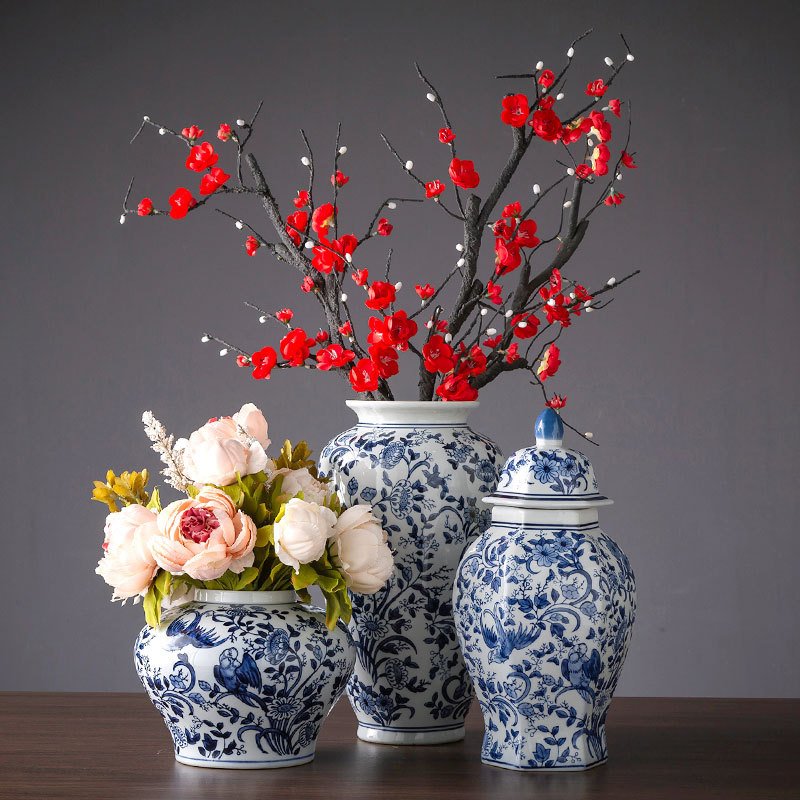
The Birthplace of Elegance: Jingdezhen
Jingdezhen, located in Jiangxi province, became the heart of porcelain production during the Ming Dynasty (1368–1644). Backed by imperial support, the city turned into a powerhouse of ceramic innovation. Artisans developed highly refined techniques, incorporating imported Persian cobalt to produce deep, vibrant blues.
This fusion of raw material and technical skill resulted in a revolutionary art form that blended functionality with aesthetic excellence.
Artistry and Symbolism in Ming Porcelain
Each blue-and-white piece was more than decorative—it told a story. Common motifs included:
Dragons: imperial power and strength
Lotus flowers: purity and harmony
Landscapes and poetry: intellectual refinement
Phoenixes and cranes: peace and immortality
Image: Close-up of blue-and-white motif on a Ming porcelain bowl
The meticulous painting process involved applying cobalt oxide under the glaze, requiring great skill and speed before the glaze set. These works were then fired at over 1300°C in dragon kilns, resulting in stunningly durable yet delicate objects.
Citation: Kerr, Rose, and Nigel Wood. Science and Civilisation in China, Volume 5: Chemistry and Chemical Technology, Part 12: Ceramic Technology. Cambridge University Press, 2004.
A Global Commodity: From China to the World
As China opened to maritime trade, blue-and-white porcelain became a key export. European and Middle Eastern elites coveted these ceramics for their refinement and exotic appeal.
Key Milestones in Global Spread:
15th Century: Shipped via the Silk Road and maritime routes to Southeast Asia, India, and the Middle East
16th–17th Century: European powers like Portugal and the Netherlands imported millions of pieces
18th Century: Inspired local versions like Delftware (Netherlands) and Iznik pottery (Ottoman Empire)
Image: Global trade routes of Ming Dynasty porcelain exports (Wikimedia Commons)
Reference: Finlay, Robert. The Pilgrim Art: Cultures of Porcelain in World History. University of California Press, 2010.
Modern Relevance and Cultural Legacy
Today, Ming porcelain is exhibited in premier institutions:
The British Museum (London)
The Palace Museum (Beijing)
The Metropolitan Museum of Art (New York)
Contemporary designers and artists often incorporate Ming motifs in fashion, architecture, and homeware. From haute couture runways to minimalist interiors, the blue-and-white palette continues to signify elegance and cultural depth.
Image: Porcelain-inspired fashion by contemporary designer
Conclusion: A Timeless Legacy
Ming Dynasty blue-and-white porcelain is a cultural ambassador that continues to fascinate across borders and generations. From its origins in Jingdezhen to its global resonance, these ceramics symbolize the pinnacle of Chinese craftsmanship and artistic diplomacy.
Whether admired in a museum or on a modern dinner table, their legacy endures—quietly elegant, profoundly human, and universally admired.
 English